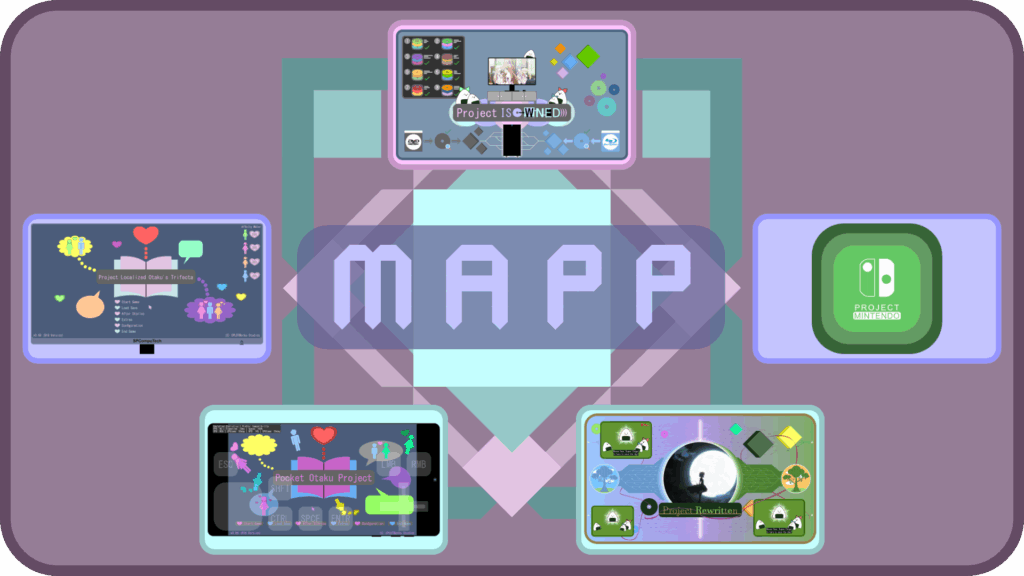
About MAPP
MAPP, or the Multimedia Analysis and Preservation Project was the first personal project I’ve created with three objectives in mind: acquiring various types of media, analyzing said media, and more importantly the preservation of media. The specific types of media involved in this project are Nintendo (and other publishers’) games primarily on the Nintendo Switch, anime, game/anime soundtracks, and visual novels. Originally, this project was intended to be used only as an escape from my emotional and mentally taxing past, and the stresses and worries of daily life. However as time passed by, I gradually realized the positive impact this project had made in my life and so I decided to make it a lifelong project in an effort to continue improving myself as a person, while exploring or deepening my personal interests in ways I never thought was possible. By also sharing this project and the stories behind it with you, perhaps I can make a difference in your life. With that said, I hope you take the time to read through the stories behind the projects that kept me moving forward.
MAPP’s History
ASIP – Animated Storytelling Immersion Project (2020-2021)
While MAPP becoming the first master project may sound or appear recent from your perspective, MAPP’s history actually goes all the way back to 2020, during the COVID pandemic. At that time, ASIP, or the Animated Storytelling Immersion Project, was the first personal project that I’ve created after reaching the end of my “moving on” phase from a past that I personally wanted to be forgotten as quickly as possible. If you guessed that this project was related to anime, you’re correct. I still remember the first anime I’ve watched on Crunchyroll under this project, which was Sword Art Online, before moving on to watch Date A Live, Re:Zero, and countless others. While ASIP’s sole objective at first was to watch anime that seemed relevant to my preferences and/or life experiences, the project quickly turned into something far greater when I decided to not only watch the anime, but to try learning something from it. In other words, I began trying to decipher what message an episode or the entire anime was trying to convey to the viewers. Whatever it was that I learned, be it something practical or philosophical, I would make a note of it and even try implement it in my life if I believe that it could create a positive impact. While it did took time and mental energy to process everything for just one anime (a lot of both in cases where an anime spans multiple seasons), I’d say that it provided a better experience than watching the anime (just for entertainment). To me, this was my way to be immersed into the anime that I was watching, hence the word “immersion” in ASIP.
VSIP – Virtual Storytelling Immersion Project & MAP – Moral Adoption Project (2021-2022)
After watching and analyzing a total of sixty-one anime within the span of a year (which was an astonishing number for me given the time it took), I decided to stop creating analysis entries and postpone the project because of another project that I had created and started as a sister project of ASIP. This would be VSIP, or the Virtual Storytelling Immersion Project. While this project’s objectives are exactly the same as ASIP, the main difference between it and ASIP was the kind of media that would be viewed and analyzed. If you guessed visual novels (VNs for short), you’re correct. There was a time where the proposed target media for this project was going to be RPGs since games in this genre typically had story-rich content which meets the criteria, but I eventually settled on VNs because it was more simpler for me to mentally digest or to put it differently, it felt like reading an “interactive e-book/graphic novel” which I personally preferred. While VNs in nature are typically designed for mature and/or adult readers (and you’ll quickly see why if you do your own research), the main focus for me and the project was whether the story in the VNs felt relevant enough for me to analyze. If the VN didn’t sufficiently meet that criteria, I would still play through it but I would analyze only the parts that matter or in some cases make no analysis. Some time after VSIP came into existence, I renamed this project and ASIP to MAP for Visual Novels and MAP for Anime respectively, where MAP stands for Moral Adoption Project to put an emphasis on both projects’ objectives. Unfortunately after reading and analyzing four VNs, I realized that it was still a time and mind consuming process and so I decided to make changes to how I record data. I also began to classify VNs based on its content, where VNs with relevant content and potential to be impactful were read and analyzed, and VNs with irrelevant content and no potential to be impactful (or in other words, VNs that are made for “entertainment”) were only read.
MAPP – Multimedia Analysis and Preservation Project (2022 – Present)
Not long after making these changes, I decided to rename both MAPs to MAPP for Anime and MAPP for Visual Novels respectively after I decided to add another objective to the projects: media preservation. This objective was added after three specific events took place: first was purchasing a set of anime DVDs and Blu-rays for the first time (most of which I previously watched on Crunchyroll). Second, Crunchyroll’s acquisition of Right Stuf Anime and later on the completed merger of Crunchyroll and Funimation. Lastly, Nintendo’s decision to discontinue the 3DS/Wii U Eshop and their online services. I would explain in detail the first two under PISO and the third under Project Mintendo (see both projects under MAPP Subsidiaries). This subsequently led to the proposal of Project Yggdrasil. I went back to analyzing visual novels for a bit and after testing the new methods on data recording on six more visual novels, I did notice a positive change in the data recording process (regarding time spent per visual novel) but I felt like it didn’t give enough momentum for me to continue so I decided to stop creating analysis entries and temporarily postpone this project and shift my focus on the anime side of the project and on Project Mintendo, with an emphasis on media preservation this time around. Once Project Yggdrasil began and after I constructed the Yggdrasil Server, it allowed me to accommodate MAPP and its subsidiary projects more effectively. Fast forward to today, what once began as a simple project to escape the stresses and worries of my past turned into an ongoing journey to express myself and deepen my interests. You could say what started as a mere seedling grew into a maturing tree with room to grow and someday become a great tree.
MAPP Subsidiaries
PISO (Project ISOwned)
Project ID: MAPP-01a-PISO
Live project status: ACTIVE (INTERMITTENT)
Project launched on: November 2022
Former project aliases:
- ASIP (Animated Storytelling Immersion Project)
- MAP for Anime (Moral Adoption Project for Anime)
- MAPP for Anime (Multimedia Analysis and Preservation Project for Anime)
An introduction to Project ISOwned and the Dystopian Future of “Owning Nothing”
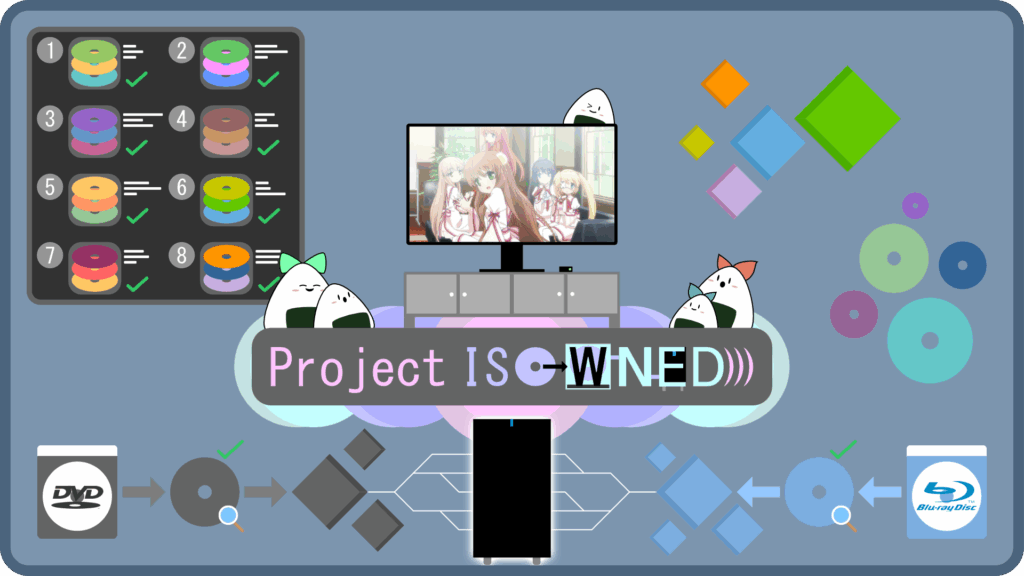
Project ISOwned (PISO for short) is a lifelong project dedicated to preserving anime and their respective ISOs (I call them AnISOs) that are relevant to me and my preferences, especially those no longer streamed on popular anime streaming platforms such as Crunchyroll or HIDIVE. PISO is also associated with Project Onigiri where every physical copy of anime I’ve ripped are stored in the Yggdrasil Server and streamed from it via Jellyfin. This project began on November 2022 when I made my first purchase on anime DVDs and Blu-rays, primarily those that I’ve previously watched on Crunchyroll, and when I began to realize the significance of owning a physical copy of any media (not just anime). In the past, I watched my anime on Crunchyroll and for some time (particularly during ASIP’s heydays) I never had any major issue with it until I began watching videos from major tech influencers on YouTube (you can get a good guess who I’m talking about) regarding the issue of streaming media and the possible dystopian future of “owning nothing”. Basically, whatever you watch on any streaming platform and how long that anime, TV show, or movie will stay on that streaming platform is entirely at the hands of the company who runs that streaming platform. Once the license expires for that company to stream that media, the company can choose either to extend the license or not. My assumption is that the decision depends on statistics (how many or how often people watched, or how popular/relevant is it to people) and cost (to extend that license for a set amount of time). In most cases or if the statistics show a net positive impact on their streaming platform’s viewership or even just their bottom line and especially for a long time, the company will extend that license. Unfortunately, there would be times where they don’t renew or extend the license, which can happen at any time and without any warning for their customers/viewers. While DVDs and Blu-rays have been around before and after streaming services began to appear and truly gain traction, not as many people buy them nowadays and they’ve mostly leaned on “convenience” when it comes to how they want to watch media. That’s when the possibility of a dystopian future of “owning nothing” began to surface, where physical media such as DVDs and Blu-rays are gradually deemed obsolete and everyone would have to rely on some kind of “digital service” to access any kind of media. With skyrocketing subscription costs and the degradation of quality from streaming services which subsequently led to the resurgence of piracy, people began to realize or rediscover the significance of owning physical copies of media as a safer, potentially budget-friendly, and sustainable alternative to watching media. By owning a physical copy of your favorite media, you essentially own it forever or until that physical copy can’t be played anymore due to wear and tear or disc rot, though the latter can be solved by creating digital backups of that copy, which is explained here (link coming soon).
The Monopolistic or Anti-competitive Nature of Media Companies
Besides the risk of “owning nothing” when it comes to media, companies (particularly monopolistic ones) “merging” with or the acquisition of competitors is another potential way to lose access to your favorite media. Examples of this (from my personal experience) would be Crunchyroll’s merger with Funimation (its largest rival), and acquisition of Right Stuf Anime (I’ll refer to it as RiSA going forward) on October 2023. While Funimation coexisted with Crunchyroll for years after the initial acquisition, it took until April 2024 for its content to be migrated to Crunchyroll and be officially retired. The merger itself wouldn’t really be an issue until I realized three things: first, those subscribed to Funimation were forced to transition to Crunchyroll to access the same content, with subscriptions costing more per month compared to Funimation. Second, those who owned digital copies of their anime on Funimation won’t be able to access them after the merger because the site itself (presumably where those digital copies reside) would be shutting down. For context, if you purchased a physical copy of some anime from Funimation, it will also come with a code inside for you to redeem a digital copy of that anime on their website. This was a great alternative to streaming since you own that digital copy and you can access it anytime and anywhere at no additional cost. Since I’m tech literate, losing access to digital copies of Funimation anime after the merger wasn’t a deal breaker for me since I can simply rip the anime on the discs I own and get the same result. But for those who aren’t tech literate or those who don’t know how to rip a disc, that convenience of taking your Funimation anime that you physically own anywhere was taken away just like that. Also, ripping anime (or any other media on disc) that you own can be complex, time-consuming, and in some cases costly, since there are many risks to look out for if you’re looking for a “perfect rip” and I’ve had my own share of problems when I began ripping my steadily growing anime DVD and Blu-ray collection. Lastly third, is the fact that not all of Funimation’s content will make the transition to Crunchyroll’s already massive catalogue following the merger’s completion. These include anime that were English-dubbed, uncensored, and/or simply an exclusive to Funimation. Those subscribed to Funimation were either forced to transition to Crunchyroll or subscribe to HIDIVE (arguably one of the last if not the last somewhat competent anime streaming service competitor that’s still safe from Crunchyroll’s (and Sony’s) grasp), desperately hoping that particular anime they watched on Funimation (regardless of which version it was) will also be there, only to find out that it’s nowhere to be found presumably because either the license to stream that particular anime/version of that anime has expired and the streaming service/company doesn’t seek to renew that license (due to reasons aforementioned), or the license doesn’t exist for the streaming service/company in the first place.
What made me start moving away from subscription services as much as possible and noticing Sony (owner of Crunchyroll, Funimation, and Aniplex) showing its monopolistic or anti-competitive nature was when Crunchyroll announced the acquisition of RiSA which owns/controls Nozomi Entertainment (RiSA’s production division). After I noticed damage on my shipment from my first and only purchase on the Crunchyroll store and reading on Reddit about the overall customer experience purchasing from the Crunchyroll store (particularly about the quality of their shipments), I began to search for alternate anime stores with better customer experience and it quickly led me to RiSA’s store. After buying my second batch of anime DVDs and Blu-rays from RiSA, I was astonished by the contrast in the quality and care of their shipments, and customer support compared to Crunchyroll’s. It didn’t take long before I became a regular customer at RiSA because of that alone up until that fateful announcement from Crunchyroll that they’ve acquired RiSA. I was disappointed and along with countless others who had the same sentiment about the sudden news, since it meant that we’ve lost a competent alternative to Crunchyroll’s store and shows the monopolistic or anti-competitive nature of Crunchyroll (which extends to Sony, its parent company). The timing also affected my last two orders from RiSA since these were pre-orders and the estimated shipping date was set long after the acquisition was complete. During that time, the current status of my pre-orders were stuck in limbo (not wanting to give Crunchyroll’s atrocious customer support another try) and I even believed they would never fulfill those pre-orders. Fortunately in the end, my pre-orders (and orders from those who also shopped at RiSA before the acquisition) were still honored by Crunchyroll and were even shipped out under RiSA’s name though it did take much longer than I estimated, probably because they had to take orders from both Crunchyroll and RiSA stores into account. While I’ve already found other outlets to fill in RiSA’s gap, primarily Robert’s Anime Corner Store (RACS), eBay and ZenMarket, the impact that the merger had left still lingers and I have a feeling that this won’t be the last time we’ll see Crunchyroll (or Sony) do something like this.
The Solution: Go Physical and Build Your Own Streaming Service
Because of Crunchyroll’s (and Sony’s) anti-competitive and monopolistic behavior, the growing cost of subscribing to Crunchyroll, the degrading quality of their services, and the fact that I no longer have the trust nor confidence for them to serve their customers and care for them right, I proposed a project to prove to myself that perhaps I (or anyone) can do better than them, and that project was Project ISOwned (or PISO). I’ve created PISO in an effort to not only escape (or at least hinder if it’s unavoidable) living that potential dystopian future, but to preserve what’s essentially been my “compass” for me. By preserving anime that guided me and cheered me up through difficult times, I can perhaps provide the same to someone else later on. The way PISO works is split into five parts: getting a physical copy of any anime, ripping the discs’ contents, encoding the ripped anime with more efficient video codecs (to save hard drive space), creating (multiple) backups of the ripped contents before backing them up on your personal server (preferably one that you built yourself), and lastly streaming that anime you’ve backed up through a media application that’s self-hosted on your server such as Jellyfin. When you think about the entire process, you’re basically creating your own private “streaming service” where you’re in control and not some other company. You choose what you want to watch in your collection, watch your collection anytime and anywhere, all with no recurring cost to access them nor fear that they’ll one day “disappear” without warning. While the upfront cost, complexity, and other risks can quickly discourage you to take the same route I took, this project can be replicated on a small budget to start and then you can expand from there at your own pace (you can check out my guide for building your own media server here (link coming soon) or to see my server’s specifications as reference you can visit the Project Yggdrasil page). With that said, if you want to ensure your favorite anime, TV show, or movie will continue to exist for years to come and prove to anti-competitive and monopolistic companies that you can do better than them when it comes to preserving media and/or caring for its customers, unsubscribe to all streaming services, buy physical copies of your favorite media, rip and back up those discs, stream them on your own server, and start learning to love owning physical media again.
PLOT (Project Localized Otaku’s Trifecta)
Project ID: MAPP-02a-PLOT
Live project status: ACTIVE (INTERMITTENT)
Project launched on: August 2024
Former project aliases:
- VSIP (Virtual Storytelling Immersion Project)
- MAP for VNs (Moral Adoption Project for Visual Novels)
- MAPP for VNs (Multimedia Analysis and Preservation Project for Visual Novels)
An Introduction to Project Localized Otaku’s Trifecta
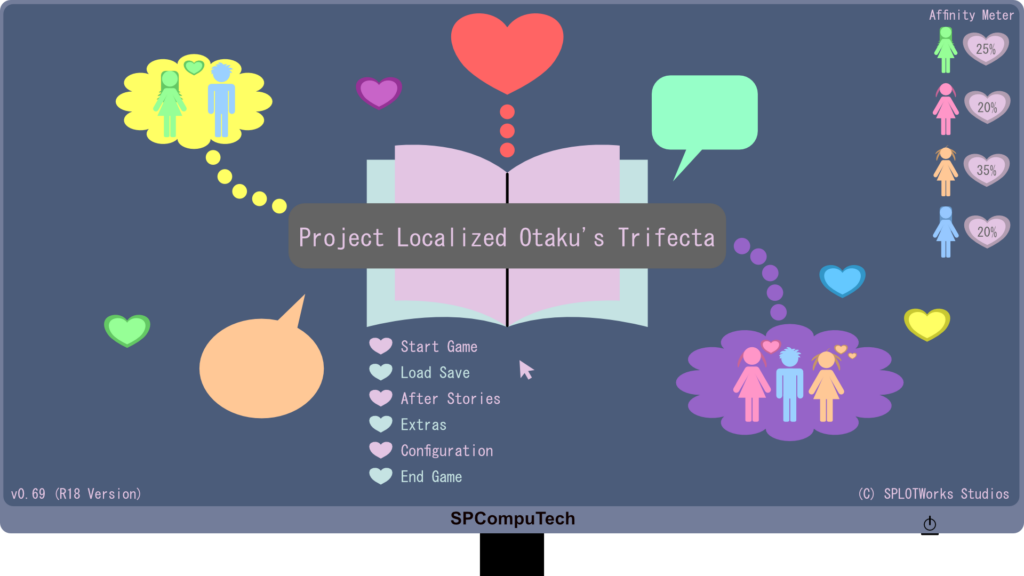
Project Localized Otaku’s Trifecta (PLOT for short) is the sister project of PISO and thus shares very similar objectives and philosophies as PISO, with the main difference being the media being analyzed and preserved, which are visual novels (VNs for short) and their respective ISOs (I call them ViNISOs) that are relevant to me and my preferences. While PISO is more focused on the preservation aspect of MAPP, PLOT on the other hand is more focused towards on the analysis aspect of MAPP though that doesn’t mean I would hold the preservation aspect of the project with less importance, which is more evident if an anime listed from PISO was adapted from a VN (the reference/source material). This project was first proposed on June 2021 before officially starting on the following month, nearly a year after watching an untranslated playthrough of Date A Live: Ren Dystopia on YouTube long before this particular VN became localized and released on Steam in North America and shortly before ASIP was created, realizing for the first time the potential of VNs when it comes to the kind of impact it can leave on me and what I can learn. I also thought that visual novels were more effective in delivering its “message” to its readers compared to anime and because of that, I created VSIP as a sister project to ASIP the following year and purchased my first batch of VNs to read and analyze. These were Date A Live: Rio Reincarnation (which also included Date A Live: Rinne Utopia and Date A Live: Arusu Install, two previous entries in the Date A Live visual novel saga), Making Lovers, Dal Segno, and Sabbat of the Witch.
To provide some context regarding the state of VN preservation, they often don’t suffer the issue of availability since the vast majority of VNs are sold in both physical and digital download versions (with both typically being DRM-free). There’s also a great catalogue of VNs that have been English localized. However, the issue of VNs not being English localized (either in physical or digital form), and VNs potentially being lost to time, licensing, negligence, or lack of general interest and proper exposure in other markets outside of Japan are still present especially given the quantity of VNs that exist today (which likely eclipses the amount of anime that also exist). Even though there are people, VN fan communities, and even companies that work hard on creating English translations/localizations of VNs, or restoring original (mature or adult) content that might’ve been censored or even removed in newer versions of VNs (which have been redesigned to be PG-rated or in other words be suitable for “all ages”) via patches (both official and unofficial), they’re severely outnumbered by the vast amount of VNs out there and trying to find sufficient manpower and budget to modify, translate, proofread, debug, or playtest VNs can be difficult at times. Depending on the manpower and budget allocated per project, getting a single VN localized can take months or even years. In worst cases, progress can come to a complete standstill or worse still the project can get cancelled. These barriers and others limit the amount of VNs readers (particularly us here in the west) have access to.
Being Immersed with Words and Pictures Worth a Thousand More Words
When I started playing (or rather reading) my first VNs, it was a different experience for me compared to watching anime when it comes to how the story was told since you’re entirely reliant on the words, static (and even motion) images, character sprites, visual and sound effects, and the music that are seen and heard on screen to help you “see and hear” the story. Being able to read at my own pace allowed me to become comfortably immersed with everything and everyone in the world within the story, and also allowed me to notice subtle or important details that either aids me in my playthrough or in my analysis. However, what made the story much more immersive were the choices that the protagonist (the reader) has to make from time to time as you play the VN. The choices you made changes the fate of one or multiple characters including the protagonist, and has its own set of consequences where after reaching a certain threshold will lead you to a good or bad ending. This prompted the reader to think carefully and choose what the reader thinks is best for the protagonist and the characters involved in the scenario or story. Having choices also provided VNs a level of “replay value”, where it makes you want to start the story from the beginning or return to that specific moment and make different choices to see other outcomes. That aspect alone was enough to make me convince myself that VNs have the potential to be just as or more effective and valuable than watching anime when it came to finding some kind of message or silver lining (preferably practical or relatable ones) that I can utilize in life. The way I see it is that anime typically forces you to see a story through a single path or perspective (mainly the protagonist’s) with a bit of other paths or perspectives shown to provide context and move the story forward, while VNs allow you to see through almost every possible path or perspective in a story, typically leaving as little questions unanswered as possible for the reader.
Bonus Trivia: Why Call it PLOT???
I called this project PLOT because first, every VN I’ve purchased and/or read are English localizations (translations) of the original material, hence the letter “L” in PLOT. This however meant that I’m relying on the translators and other staff who made the localization possible to deliver an accurate translation and rendition of the VN (which varies from one visual novel to another) but to be honest with you, having the VN translated regardless of its accuracy is infinitely better than having no translation at all. Second, well the “O” is kind of self-explanatory but I’ll say this right now that I’m only a “part-time otaku” (whatever that means). Lastly third, the word “trifecta” (the “T” in PLOT) is my way of describing a VN. How I describe a visual novel would be if you were to combine the three things into one that a typical otaku might enjoy: anime, (adult) doujinshi or manga, and video games.
Project Mintendo
Project ID: MAPP-02-MINT
Live project status: STANDBY
Project launched on: April 2022
-> Project Link (Coming Soon)
An Introduction to Project Mintendo
Project Mintendo is a media preservation project dedicated to preserving and emulating Nintendo (and other publisher’s) games on both the Nintendo 3DS and Nintendo Switch. While at first this project was only intended to own and/or preserve limited editions of physical Nintendo 3DS and Nintendo Switch games, a much higher emphasis on preservation was implemented when Nintendo decided to shut down the Nintendo eShop for the 3DS/WiiU on March 2023 and later their respective online services on April 2024, also prompting me to dabble into (Nintendo) console emulation for the first time. The importance and interest on preservation and emulation grew further when Nintendo also began its crackdown on content showing how to jailbreak vulnerable Nintendo Switch systems, content showing Nintendo Switch games being emulated on non-native hardware, and lastly the emulators for Nintendo 3DS and Nintendo Switch games themselves, notably Citra, Yuzu, and most recently Ryujinx.
Nintendo’s Unwillingness to Keep its Own Games Alive
When Nintendo decided to shut down the Nintendo eShop for the 3DS/WiiU and later their respective online services, this clearly made many people (including myself) who still own a Nintendo 3DS and/or a WiiU upset or worried since many digital games, DLCs, and other content (especially those that are console exclusive) that reside on their respective eShops, and their online services were at risk of becoming permanently inaccessible. People were scrambling to try to purchase games, DLCs, and other content before the deadline since it was very likely their last chance to get them before they’re gone, possibly forever. While many of the digital games have physical versions that can be bought from various resellers (brick and mortar stores, eBay, etc.), anything else that had no physical version were left out to unceremoniously disappear into nothingness. Unless you’re willing to dabble into console jailbreaking and piracy, there was no easy way to get anything digital for the 3DS or WiiU after Nintendo pulled the plug. Even though many of these games and the console themselves left some kind of impact for people or even Nintendo itself as a whole, this goes to show that Nintendo isn’t really willing to keep their aging games and consoles alive (or at least make them available on their latest console(s) in the case of the former), particularly if it’s deemed “obsolete” or if it no longer contributes significantly to them and/or their bottom line. This forced some people to try and do the work that Nintendo doesn’t want to do, even if it means taking advantage of the “legal gray area” and other obscure methods to keep parts of Nintendo’s own history intact. What’s unfortunate is that Nintendo may not hold those who actively try and preserve parts of their history intact with high regard, and may even see these people as “bad actors” even if whatever they’re doing doesn’t actually harm Nintendo in some way nor the law. The same goes true for the topic of emulation, which I explain more in detail below.
Nintendo’s Refusal of Acknowledging that Emulation ≠ Piracy
Ever since emulators for Nintendo consoles/games had existed, such as Dolphin for the Gamecube and Wii, CemU for the WiiU, Citra for the 3DS family, and lastly Yuzu or Ryujinx for the Switch, Nintendo has been keeping a very close eye on them and have even taken action to try taking some of these emulators down if they believe that these pose a large enough threat to their brand in some way, even if these emulators and those who maintain them mostly haven’t done anything wrong (from a legal standpoint). What simply doesn’t make sense however, Nintendo’s belief and reason for going after these emulators and the people who maintain them is that using any of these emulators is considered to be an act of “digital/content piracy,” even if someone owns a physical copy of the games they emulate. While some bad actors have shown pirating Nintendo games (even those that haven’t been formally released to the public) and even running them on an emulator, people who maintain the emulators strongly emphasize their stance against piracy and using their software to play pirated Nintendo games. In spite of this, these bad actors decide to ignore that fact and abuse their software in a way that not only harms the people who maintain the emulators but Nintendo as well, something that both take very seriously. Unfortunately and to reiterate what was mentioned earlier, even if the emulators are mostly harmless, Nintendo still associates emulators with piracy because of these bad actors and thus have begun their crackdown on popular emulators, whether or not they’re used for piracy. People who use or rely on emulators are upset about Nintendo’s belief and stance on emulation since it meant that (from Nintendo’s perspective) anyone who tries using an emulator is also a “pirate”. Nintendo’s crackdown also extends to hardware and/or software that bypasses their consoles’ security and allows the decryption of the consoles’ unique hardware keys (which are essential for emulators), and software that allows the modification of the stock operating system or games. With all that said, emulation where it stands today is in a state of instability and uncertainty. Nintendo’s misleading belief and stance on emulation is likely never going to change, and with popular emulators such as Citra, Yuzu, and Ryujinx taken down as a result of this, the effort of preserving Nintendo games and emulation in general have taken a step backward which might take some time to recover and possibly move forward again.
POP (Pocket Otaku Project)
Project ID: MAPP-02b-POP
Live project status: ACTIVE (INTERMITTENT)
Project launched on: July 2024
An Introduction to Pocket Otaku Project and a Glimpse Into an Otaku’s Experiment
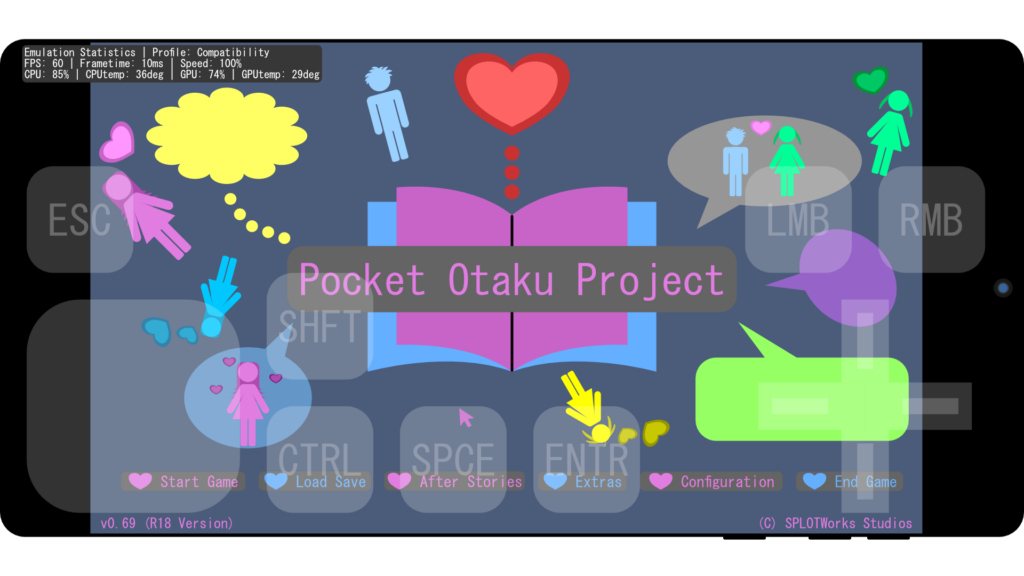
Pocket Otaku Project (POP for short) is an expansion project for PLOT, tasked with emulating DRM-free VNs (originally designed for Windows systems) using Winlator (a Windows emulator for Android devices), determining which VNs are compatible with the emulator, and showing fellow otakus a more convenient (and potentially discreet) way of playing VNs. The Pocket Otaku Project was conceived not long after discovering Winlator on Github and its ability to emulate DRM-free Windows games on a non-Windows device and operating system (such as Android OS), using Wine and Box86/Box64. Since any VN you can find on Windows don’t require powerful or even modest hardware for stable gameplay (all can run on a CPU’s integrated graphics just fine) with many also having no DRM, porting and emulating applicable VNs on Winlator should be easily feasible since it has been shown running more computationally and graphically demanding games from the last decade. Thus to prove my hypothesis, I copied and transferred a variety of VNs (which were DRM-free) from my PC to my Samsung Galaxy S22 Ultra with Winlator already installed. After adding them to the appropriate folder where Winlator has access to, I began tweaking the container’s parameters (the emulator’s environment) where compatibility takes priority over performance, then added touch controls to simulate a mouse and keyboard before testing one VN. To my surprise, it worked surprisingly well and I was able to play through the entire VN without encountering any major issues.
Mixed Samples and Results, with Room for Optimism
However, testing other VNs on Winlator provided different results. Some VNs have degraded performance, one VN would crash when the intro movie plays, and one VN only shows a black screen with music playing in the background, unable to interact with it in any way, and in worst cases the VN never boots up. Knowing this meant that Winlator still has its limitations but that also meant there’s plenty of room for tweaking or future improvements. In fact, after updating Winlator and tweaking the emulator’s environment, I tried to emulate one of the problematic VNs again that I mentioned and it was able to play through the intro movie which allowed me to progress further into the VN, albeit with a severe but temporary hit on performance as the intro movie played or whenever I skip read text/dialogue. I considered this to be a step in the right direction, and I’m hoping that the developer(s) of Winlator will continue improving the emulator. This project was also inspired by the fact that some JP localized VNs have a native Android version besides the typical Windows or console version, proving that VNs can be ported to (or emulated in) mobile devices with compliant hardware and software. Hopefully through the Pocket Otaku Project, more people (including otakus) can not only learn more about Winlator and what it can do, but also have a glimpse of what the future of mobile gaming could look like, especially as more smartphones discreetly become pocketable yet still capable mini-computers.
Project Rewritten
Project ID: MAPP-01b-REWR
Live project status: STANDBY
Project launched on: August 2024
An Introduction to Project Rewritten and the Experiment to Change Rewrite’s Fate
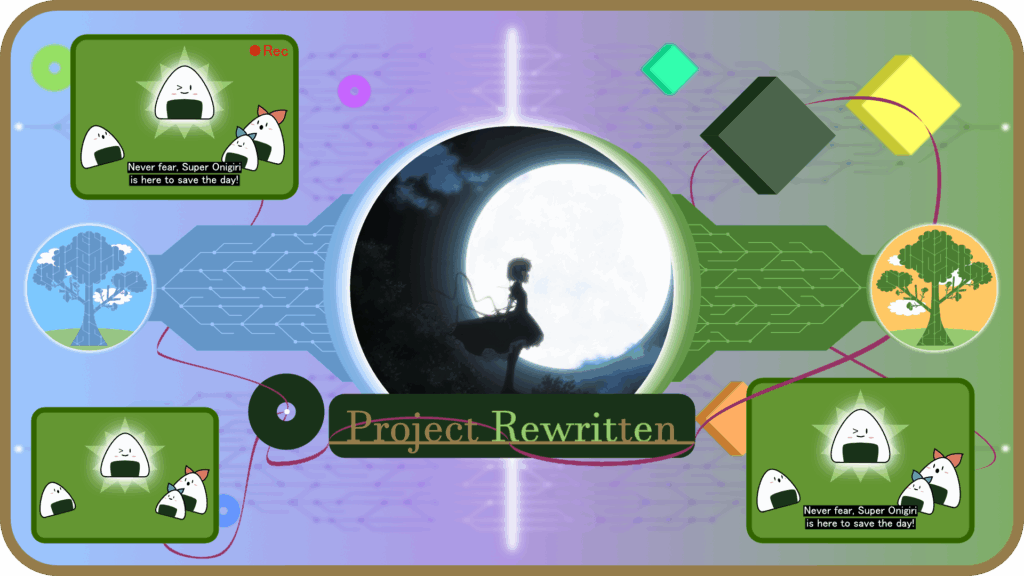
Project Rewritten is an expansion project for PISO, with the objective of recreating an English-subbed version of any anime using both an Japanese imported copy of the anime in question and a “recorded anime ISO” (I call them RAnISOs) from a “master source” (a streaming service) which contains the anime with English subtitles. This project is dedicated to preserving anime with English-subbed versions that are available on popular anime streaming platforms such as Crunchyroll or HIDIVE and a physical English-subbed version of the anime doesn’t exist (yet), but a physical un-subbed (JP) version is available for purchase. In addition, this project is for recreating subtitles on a Japanese imported Blu-ray copy of an anime using subtitles on an English subbed/dubbed DVD copy, where an English subbed/dubbed Blu-ray copy of the same anime doesn’t exist. It all began when Rewrite, one particular anime by Key that I personally enjoyed watching didn’t have a physical copy with English subtitles, but an un-subbed physical copy was available. After learning a bypass to allow video recording of media with HDCP on streaming platforms such as Crunchyroll (where it had the English-subbed version of Rewrite), I recorded every episode before making the move to purchase the entire thirteen un-subbed volumes of Rewrite on eBay from a fortunate seller (and I highly thank that seller for having all volumes on hand and in great condition). With the essential materials on hand, all what’s left to do is to simply recreate the English subtitles from the RAnISO I created on the non-subtitled copy of Rewrite that I’ve ripped. The next step to figure out is how and where to recreate the subtitles. However, knowing that is only half the battle. The real challenge is the tricky and likely tedious task of matching the timing and appearance of every subtitle that appears, so that it appears as close to the RAnISO copy as possible. If it ends up being too much of a challenge or if it takes too much time, I can simplify some of the process (like the appearance of the subtitles).
The Chance to Rewrite Fate of Other Anime Stuck in the “Un-subbed Realm”
In addition of creating RAnISOs for Rewrite, I’ve also created RAnISOs for two anime movies from the Date A Live franchise: Date A Live: Mayuri Judgement and Date A Bullet. If this subtitle recreation experiment ends up being a success, this gives me enough reason to do the same for the two RAnISOs aforementioned and continue creating RAnISOs for the project as long as the anime in question is available and English-subbed on Crunchyroll or HIDIVE, and has a Japanese physical version. However if you ask me, I really think that streaming services/companies and the anime publishers can do a much better job when it comes to catering their North American customers (or customers from any other country or region for that matter), that there should be a lot more physical copies of English-subbed and/or dubbed anime out there. That way, there wouldn’t be the need for this complex, time-consuming, or costly project. Until that day comes or if at worst never comes, this project will continue its task of saving as much anime as possible from suffering a tragic fate of being neglected and/or forgotten simply because no company or publisher bothered to do one simple task.